- 1 September Opening ceremony of the academic year
No results found.
The school is transitioning to Estonian-language instruction while maintaining a high quality of teaching. An effective CLIL support system is in place for the target group of the transition.
The school community has developed a shared understanding of the individual learning path of a TTRK student and has an overview of the possibilities for shaping it during the learning process.
All teachers at Tõnismäe Reaalkool are aware of project-based learning as one approach to modern pedagogy and see opportunities to integrate it into their work.
Since 1948, more than six thousand people have graduated from secondary school .
Number of secondary school classes – 75
Number of class sets – 31
Number of students – 790
Number of teachers – 73
Tõnismäe Reaalkool has a long history that began as a two-class Russian primary school. Documents from the National Archives confirm that since 1789, there were two two-class primary schools in Reval. Copy of the document. 1873. In 1873, the Ministry of Education merged them into a single three-class city school, located at 69 Morskaja Street (now Pikk Street).
On January 1, 1874, the school had 69 students and 5 teachers, including 2 religion teachers — one from the Orthodox Church and one from the Lutheran Church.
In 1889, in connection with the 100th anniversary of its founding, the Ministry of Education decided to rename the school. The new name became Revel Primary School, named after Empress Catherine II. 24. On November 24, the event was celebrated with a grand ceremony. Under this name, the school continued to operate until the autumn of 1917. During the revolution, the school lost its name and was assigned a number.
At the end of the 17th century, public education in Estonia was mainly under the care of the church, but after the war, the Russian government also began to take responsibility for it. Although the latter recognized Lutheranism as the dominant religion in the Baltic provinces, the influence of the church declined.
Neither Estonia nor Livonia had appointed bishops. In Livonia, church life was led, as during the “Swedish era,” by an appointed general superintendent.
In the second half of the 18th century, the first attempts were made to establish universal school education. In 1756, the Livonian Landtag adopted a school organization program presented by General Superintendent Zimmermann. This program envisioned opening schools in every parish and large manor. However, the program met strong opposition from landowners.
It was only in 1786 that the Russian Empire published the Charter of Public Schools. According to this charter, main state schools with four classes (a five-year program including one preparatory year) were to be opened in provincial towns. However, even this centrally issued document did not significantly advance the development of education.
Therefore, in 1787, the Governor-General of Livonia and Estonia, J. Brown, issued a supplementary version of the charter as a patent — a new school law. According to him, the Revel Main School was opened in 1789. It was a two-class school. In 1872, it was renamed a three-class city school, and in 1889, it became the Revel Primary School named after Empress Catherine II (it has since become a four-class school).
At the beginning of this century, until 1917, the school had various names. It was called Revel Government Primary School No. III for boys, Government Primary Schools No. I and III for boys, and Government Primary School No. I for girls.
On November 20, 1917, the Revel City Council assigned the educational institution a number, and it was named Revel City Primary School No. XIX. Continuing the traditions of the Russian community, which celebrated the centenary of their national school on November 24 1889, the teachers’ council decided in the autumn of aasta sügisel otsuse: “Pidada 24. novembrit koolipäevaks”. 1925: “To observe November 24 as School Day.”
Until November 1993, the school was known as Number 19, after which it was renamed Tallinn Tõnismäe Reaalkool.
Since 1955, the school has been coeducational (before that, it was either a boys’ or girls’ school).
The first graduation of the seven-year school took place in 1945, and the first graduation of the high school occurred in 1948 (at that time, the school lasted eleven years).
Over its more than two hundred years of history, the school has changed its address several times. At the end of the 13th century, it was located at 69 Morskaja Street (now Pikk Street). In 1934, it moved to Karu Street 16 (relocating to the Jewish Gymnasium), then to Lai Street 25 (which also housed Secondary School No. 2), and later to Hariduse Street 8…
Since 1960 the school has been located in the building at the intersection of Pärnu Road and Pärna Road. and Suur-Ameerika Street (Pärnu Road 50).
The high school prepared and graduated approximately five thousand students, with 49 graduates in the most recent class. 1998. In the spring of 1998, the 50th anniversary celebration of the high school students took place.
1789 – Revel Main School opened (two-class school).
1872 – Three-class city school.
1889 – Revel Primary School was named after Empress Catherine II (the Russian State Council changed it to a four-class school on the occasion of the school’s 100th anniversary and named it after the Empress).
1910 – Revel State Primary School No. III for boys.
1912 – (From August 25, 1912, to August 5, 1914) – Revel Government Schools No. I and III for boys.
1914 – (From November 23, 1914, to March 8, 1917) – Revel Government Schools No. I and III for boys and Government Primary School No. I for girls.
1917 – (November 20) Revel City Primary School No. XIX.
1939 – Tallinn School No. 19. Algkool.
1940 – Tallinna Linna 19. Keskkool.
1942 – Tallinna 19. Algkool.
1944 – Tallinna 19. (vene õppekeelega) algkool.
1945 – Tallinna Linna Reaalkool nr 19.
1993 (november) – Tallinna Tõnismäe Reaalkool.
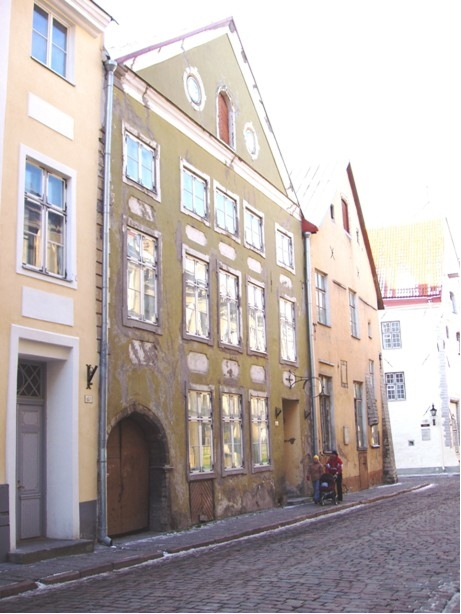
1789 - Morskaja tänav 69 (praegu Pikk tänav)
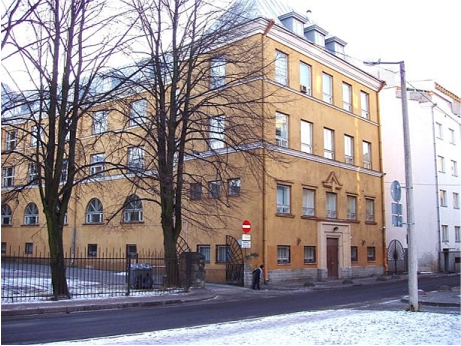
1934 - st. Karu 16 (liidetud juudi gümnaasiumile).
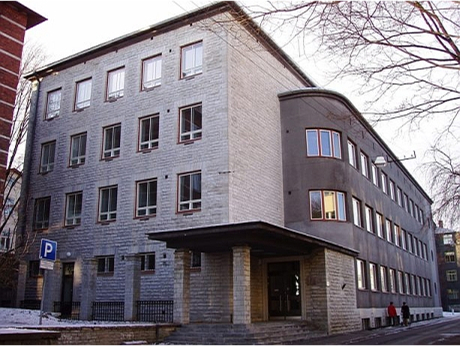
1950–1960 – tänav. Hariduse 8.
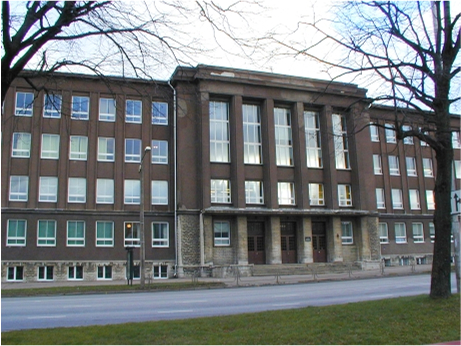
Now – Pärnu Road 50 (at the intersection of Pärnu Road and Suur-Ameerika Street).